



Tuesday, September 30, 2008

St Anne's body is found by Charlemagne

I’ve continued quoting from St Anne, Grandmother of Our Saviour by Frances Parkinson Keyes, and those quotes will be in green:

“The “priests and guardians” designated on the slab marking St Anne’s tomb have been identified, by historians more learned than this one can ever hope to be, as having lived in Apt during the 6th century.

They had acted none too soon in hiding their precious treasure. In 576 AD this city was badly damaged by an invading army of the Lombards and its surviving inhabitants, both lay and clerical, were scatted far and wide. After a century of desolation, another invasion took place, this time at the hands of the Saracens. But somehow, a few pious persons must have guarded the secret of the hidden tomb with the utmost caution, handing down their knowledge of it from one generation to another; for it cannot be wholly by accident that this hiding place was finally discovered in a great and glorious way, by a great and glorious person – none other than Charlemagne himself.”


Charlemagne regarded piously, St Anne, the mother of the Holy Virgin. He was knowledgeable of the Aptian tradition and so naturally he was keen to search for these relics in Apt itself.


The coronation of Charlemagne

“Is it possible,” Emile Rey inquires, after thus quoting from Kleinclausz and Charlemagne himself, “that a monarch so learned, so far-seeing, so powerful, could ignore St Anne? Hagiography replies ‘no!’ That is why the Carolingian litanies, composed during the Pontificate of Hadrian I, and in constant use at the palace in Aix-le-Chapelle contain the name of St Anne, whereas all other names (except for rare exceptions and for some special reason) were those of French saints.

“At what time and under what circumstances? On this point, history is positive. This pilgrimage could have been undertaken only after the coronation at Rome of the king who had become an emperor. “
The crypt under the Cathedral of St Anne in Apt

At this point in the narration there are two versions to the story of the discovery of St Anne’s relics but, not that either seriously contradict the other but one story involves a small boy...and it the version given to us by Monsignor Dubreil, Archbishop of Avignon.

“It is related that Charlemagne, having concluded one of his many expeditions, had returned to Apt. But it is not known whether his visit was for the purpose of placing his sword beside that of Ceasar on the coat of arms of Apt or of being present at the consecration of the cathedral. As this church was one of the forty charches he had promised to build if victory crowned his expeditions, it would seem that Providence wished him to be present as a witness of the miraculous discovery of the relics.

On Easter Sunday in the year 792, the Emperor assisted at the Divine Office, surrounded by the faithful and his knights. Suddenly, a youth, blind and a deaf-mute from birth, son of a lord of the place named Caseneuve de Simiane, came into the church like one inspired and led by an invisible hand.

The congregation, evidently also inspired, immediately rose up instinctively and followed him to the steps of the sanctuary. By gestures he requested a stone slab to be lifted and the place to be dug up. The Emperor, who shared in the general excitement, ordered the boy to be obeyed.
Accordingly, the stone was removed and digging was begun, and soon the crypt was discovered where lay the relics, and whence bright rays issued. “Through an opening the cypress coffer was seen and the bright light illumined the place.

Then a prodigy was witnessed which is worthy of being recalled side by side with that by which the True Cross was recognized by S. Helena. The young man, suddenly cured, cried out: ‘It is she...’ And Charlemagne, greatly excited, also cried out: ‘It is she.’ The same words were repeated by the people who fell on their knees and broke into tears. In fact, in the coffer was found a winding sheet, that enclosed the relics, on which were inscribed those words that dispelled all doubt: ‘Here lies the body of St Anne, Mother of the Glorious Virgin Mary.’”

The story’s finale to be continued next week.

Reliquary today of St Anne in St Anne's Cathedral in Apt

Tuesday, September 23, 2008

Anne's body is transferred to Apt


by Frances Parkinson Keyes.
At the time the decision had been made to transfer St Anne's holy remains to a safer part of France - to the town of Apt. St Anne's body was still encased in a simple coffer made from cedar which had come from Palestine. It was decided that the coffer needed to be made more substantial by enclosing it in another casket with lock and key.


The town of Apt


The dome of the Cathedral of Apt


In time this too, was not considered safe enough. So the decision was made to conceal the coffers altogether - a hiding place only known by a few. In a place that was was very unlikely to discovered, within the cathedral in Apt. Quoting from St Anne, Grandmother of Our Saviour:

Subterranean crypt of St Anne's Cathedral in Apt, as it is today.

"St Anne's body was then placed in an opening in the wall excavated from a subterranean gallery known as the Antrum Antiquum, which had originally been a branch of the catacombs. It was reached by a short flight of steps and hedged in by the cathedral ramparts. This wall opening, which would now become an ossuary, would be sealed in and not marked in any way; but on that part of the passage ceiling which was directly beside it a design would be carved, intelligible only to the initiate.
Ceiling of the interior crypt, Cathedral of St Anne, Apt. (Symbolic sculpture by means of which the tomb of St Anne was discovered.)


This design is still visible, in exacly the same form wherein it was graven so many centuries ago. It consists of the flowering branch of a tree, interlaced with a vine bearing both foliage and grapes. To look at it is an experience so moving that, months after gazing at it, this chronicler finds it impossible even to write of it without profound emotion. For it reveals, unmistakably, that when the stone slab was carved, even as now, men and women were reverently reciting the litany which begins:


"St Anne, Grandmother of our Saviour, pray for us." And continues: "St Ane, Root of Jesse, St Anne, Fruitful Vine....pray for us."


Personally, we require no further confirmation of our belief that this became St Anne's last resting place. But to the doubting Thomas-or Thomasne, as the case may be - has only to look at the slab beside the one which shows the root of Jesse and the fruitful vine. On this second slab appears these words: Antulfus, Alif, Anselmus, Albionus, Berardus, sac. vel cl.

Emile Rey interprets the Latin abbreviation as meaning. Sacerdotes vel clavicularii - priests and guardians - giving as his reason for doing so, that this interpretation seems "the one that is most natural and that most closely conforms to history." On the other hand, the learned antiquarian, Joseph-Marie de Suarez, Bishop of Vaison, in the 17th Century, believed them to be abbreviations for Sancti Veli Clavicularii - Guardians of the Holy Veil - namely those in charge of the relics, which were wrapped in a winding sheet, or holy veil.


Either interpretation seems admissible, in view of later records. But this author agrees with Emile Rey that the former is more natural and, therefore, has used it in continuing her story. For she also agrees with him that "this is the official seal of the relics of St Anne."


Interior of St Anne's Cathedral in Apt.


Next week:


Charlemagne discovers St Anne's relics miraclously, through the help of a deaf & dumb boy.

Monday, September 22, 2008

Scapulars for the family

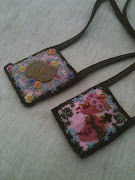
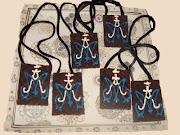
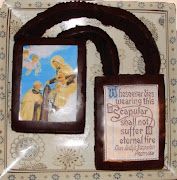
Here are the family's scapulars. And for anyone who wears this garment of Mary, you will know just how easily they break and fall apart, medals fall off etc. We really needed 'indestructible' creations.

Finally last year I bought these beautiful scapulars (as seen above) from the States, all with different religious images. I carefully chose out each one for each family member...Sacred Heart for dh as we have great family devotion to the Sacred Heart. I chose the Our Lady of Guadalupe image, and if you have come here often enough, you know why! My oldest son chose St Francis as he is his confirmation saint. My oldest daughter chose Our Lady of Lourdes, due to her Marian devotion. My next daughter chose St Therese since she has had a devotion to her since she was 2years old. Then the two younger boys had St Joseph and St Michael, their name saints.
In this image, the scapular in the top half of the picture is after I've removed the original cord and added my own, the scapular in the bottom half is how they looked when I bought them.

Even though this new brand of scapular was stronger and sturdier than any other scapular we had previously owned, we found that we wore through the cord quick enough, so I cut off all the cords and bought a few meters of strong, flat cord and sewed them down the sides and under the scapular ends with very firm, small stitches, I could make the scapular's a little longer as well.


How I originally sewed on the medals

I had wanted to sew on my two most favoured religious medals to each scapular - the Miraculous Medal and the St Benedict Medal.

The St Benedict Medals were taken to Father for a special blessing (not the normal blessing Father would give) there is a special prayer that Father recites to make this a powerful exorcism medal.

I wanted each child to have a miraculous medal as we have a deep devotion to this most blessed medal, with it's companion prayer, "Oh Mary conceived without sin, pray for us who have recourse to thee." In recent times the children and I made a Miraculous Medal Prayer Petition Mobile. This mobile was to be a visual reminder in the home for us to recite this little prayer often. But it was important that we all wear the miraculous medal, so I had decided to sew on the medals on the outside, like the image you see above.

The Miraculous Medal Prayer Petition Mobile.

The trouble is, as firmly as I sewed these medals on, they soon started disappearing off the scapulars...it happened to me and then I checked everyone else's scapulars and it was also happening to them.

What could I do?

Finally I worked out the answer.

I decided to carefully slit the back of each scapular as there is a space between the back and front. Then I carefully with small, firm stitches, sewed up the slit after I slid in a medal at each end.


Here is it all sewn up, you can hardly see where I have done it since I matched the cotton up better this time. Those medals are going nowhere!

The Culture of Life Vs The Culture of Death...

...and it doesn't get any polarizing and starkly different than this:

Here is a man who espouses all the so-called 'virtues' of what is the culture of death...that it is immoral to bring a down syndrome child into this world. This man believes that this child should be destroyed while still clinging to it's mother, in her womb. Heaven help us.

Only weeks beforehand, on the feast of Our Lady's birthday, this man, after a whole lifetime of giving, of loving, of sacrificing for those he loved and for those who came into his life, he makes the ultimate sacrifice in giving his life for his beloved, youngest child...a young man with down syndrome.

Tell me, tell me, which of these two examples, move the heart to tears as only love can?

I believe Pope John Paul II told us why in Evangelium Vitae:


"The Church knows that this Gospel of life, which she has received from her Lord, has a profound and persuasive echo in the heart of every person-believer and non-believer alike-because it marvellously fulfils all the heart's expectations while infinitely surpassing them. Even in the midst of difficulties and uncertainties, every person sincerely open to truth and goodness can, by the light of reason and the hidden action of grace, come to recognize in the natural law written in the heart (cf. Rom 2:14-15) the sacred value of human life from its very beginning until its end, and can affirm the right of every human being to have this primary good respected to the highest degree. Upon the recognition of this right, every human community and the political community itself are founded."

And tell me, which convicts the mind and will, that speaks to our common sense?

Dale Ahlquist talks of one such Apostle of Common Sense (G. K. Chesterton) when quoting from Chesterton's, "Eugenics and Other Evils", and they crystallize what we all know deep down:


"As with so many other things, Chesterton saw exactly what we see. Only he saw it long before it happened. The very title "Eugenics and Other Evils" obviously implies that eugenics is an evil, and one connected to other evils. When Chesterton attacks something that is evil, his attack is always wrapped around a defense of what is good. He is concerned that we have lost sight of what is good. We have even lost sight of what is normal. We have lost our common sense.

What is normal is this: a man and a woman fall in love, get married, and have a family. For thousands of years, men and women have been able to figure this normal thing out for themselves. This basic human freedom was part of the common experience.

The early proponents of eugenics defied this common sense by saying that men and women should not marry for love but, rather, for good breeding. They said people should not risk having children who might be handicapped or ill or weak. In other words, says Chesterton, they should not risk having children who turn out to be John Keats or Robert Louis Stevenson.

In a chilling prophecy of the abortion mentality, Chesterton says that the eugenicists have an attitude toward the unborn child that was in every other age unthinkable: "They seek his life to take it away." They have precisely the wrong idea of the purpose of medicine:

"We call in the doctor to save us from death; and, death being admittedly an evil, he has the right to administer the...most recondite pill which he may think is a cure for all such menaces of death. He has not the right to administer death as the cure for all human ills."

The normal person has always known that preventing the birth of a baby is a highly unnatural act, no matter how it is done. But it is made to sound harmless and even sensible when it is called "eugenic" or when it is called birth control or when it is called reproductive freedom. But anyone who cannot see the real evil behind such terms is what Chesterton calls a "splendid dupe".

"Evil always takes advantage of ambiguity....Evil always wins through the strength of splendid dupes; and there has in all ages been a disastrous alliance between abnormal innocence and abnormal sin."

The only way to explain what happened in Nazi Germany is that evil won through the strength of its splendid dupes: too many people thought they were doing a good thing because they believed a lie. A lie that sounded good because it was called patriotic and was supported by the scientific officialism of the regime. It is also the only way to explain what has happened in this country for the last three decades. Millions of people have believed an incredibly evil lie. A lie that sounds good because it is called "choice". A lie that sounds even better when it has scientific officialism behind it."

Dale Ahlquist finishes quoting Chesterton on eugenics with this:


"The point about eugenics and the other evils that sprang from it is that they propose to eliminate poverty simply by eliminating people. Chesterton's solution is not as simple, but it is the right one. The way to eliminate poor people is to eliminate their poverty, so that they are not poor anymore, but are still people. They deserve enough property and capital and liberty so that they can keep their families and their dignity. They are the image of God, and they must not be broken."

So what triggered the appalling rant from the man who supports the culture of death?

Sarah Palin.

Sarah Palin who is John McCain's running mate in the States...a mother of five, whose youngest, Trig, only 4 months old who is down syndrome and who Sarah has referred to as "absolutely perfect".

It irks this man that Sarah found out in her pregnancy that Trig was down syndrome and did nothing about it.

This same woman who is rattling the liberals in the US from one coast to the other, who could be the biggest threat to this culture of death in the future...why? Because she not only talks the talk..she walks the walk..her own life is a testimony to that.

Thank God there are still millions who ARE a testimony to life and love, like Thomas Vander Woude and Sarah Palin.

I also have this to say: It will be this same life-giving love that will spread the truth of, and a passion for the culture of life in the great country of America, because those who espouse the culture of death, walk the walk too..into the valley of death and leave no human legacy behind them, or if they do, probably unlikely to leave them with fruitful, lasting generations.

Tuesday, September 16, 2008

St Anne's body arrives in France


Taken from the book, St Anne, Grandmother of Our Saviour by Frances Parkinson Keyes.
After the death of Christ, the Jewish people were antagonistic towards the new, growing faith that resentment which reached greater heights a decade later. Fourteen years after Christ’s death and resurrection, the three siblings, Lazarus, Martha and Mary Magdalene found themselves, along with a group of Christians with them, under attack. It is not hard to see why Lazarus in particular would be viewed with hostility by the Sanhedrin, who had no belief in an after life and would have been troubled and angered by the growing fame of Lazarus, ‘the man who was raised from the tomb’ by Christ Himself. There were a couple of well known biblical characters in this group besides the three siblings – the two Mary’s - Mary Jacobe (mother of James the lesser) and Mary Salome (mother of the apostles, James and John), St Sidonius (the blind man in the Bible healed by Christ). Also the maid to one of the Mary's, Sera (St Sarah, a native Eygptian whose cult is connected to the two Marys) and St Maximin, the cousin to the trio and the man reported to have baptized Mary Magdalene. Tradition holds that a Jewish mob forced this group into a boat and set it adrift without any oars, sails or provisions. With them they carried a revered relic – the body of St Anne, mother to Our Lady. Divine Providence kept them safe upon the sea and gently guided the boat to the shores of Southern France. They first landed at the port city of Marseilles, there Lazarus settled and became the first Bishop of Marseilles. Mary Magdalene later retreated to the region of Sainte Baume for a life of seclusion and contemplation, after initially supporting her brother’s missionary work. The two Mary’s went by a smaller sea vessel with Sera to a wild and marshy, sea port region later to be named, Ste-Maries-de-la-Mer. It was a fishing village, built on an island in the heart of the Camargue, where the Petit Rhône joins the sea. The original village was grouped around the Notre-Dame-de-la-Mer church which had been built originally as an oratory to the Virgin by these first missionaries. St Martha went to Tarascon, a town that converted to Christianity after Martha defeated the Tarasque (sea monster) that had been terrorizing the district. The body of St Anne had been safe in the keeping of Lazarus in Marseilles initially until it became the scene of repeated invasion and siege. In time a successor to Lazarus decided that this holy relic was not safe and after receiving counsel with other churchmen it was decided that the Bishopric of Apt, founded by St Maximin, should have the honour of keeping and protecting her venerated remains. To be continued next week!

Friday, September 12, 2008

The Holy Name of Mary

Today is the glorious feast of the Holy Name of Mary. My dh’s birthday as well, what a blessed feast to be born on! Here is a most beautiful explanation of the devotion to that Holy Name..Mary.

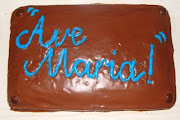
Over at Catholic Cuisine I have made a cake for the feast – and the cake has been especially made in remembrance of historical story in Spain, under reign of Queen Isabel, a story of the defense of the phrase, “Ave Maria!” It is a very small excerpt from the book The Last Crusader: Isabella of Spain by William Thomas Walsh. A simply masterful book, very, VERY thick but so enthralling that I read it in 4 days!


Defending the ‘Ave Maria’

Starting on page 326.

.....”God has permitted this to happen to test our faith,” she said. (Queen Isabel) “If we stand firm He will yet give us victory;” and she commanded the army to rebuild the camp at once, not in linen and silk, but in stone. Foundations were dug, rocks were drawn from the neighboring hills, and day after day the buildings arose in the sight of the puzzled Arabs. The whole army, swelled by new recruits to 80,000, engaged in the work, and within three months, as if by a miracle, a complete new city, with towers, battlements and walls, stood in the midst of the plain. Two principal streets in the form of a great cross, ran north and south and east and west to four gates, through a public square large enough to contain the whole army. From the topmost tower was raised the silver cross of the Crusade, with the banners of Santiago and of Castile and Aragon. “Call the city Isabel, after the Queen!” cried the cavaliers and the soldiers. But she insisted upon its being name Santa Fe, Holy Faith.

The King had forbidden those costly skirmishes in which the light-armed Moors usually had the advantage. But when the bands of Saracen cavalry failed to draw fire from their enemies, individuals among them began riding close to the Christian camp, with challenges to personal combat. At first the Christians responded; but after Fernando had lost some of his best men, he forbade all duels of any sort. “Hunger alone will win the city for us,” and Isabel to the French ambassador.

Among the Moors, however, there was a cavalier named Yarfe, a giant in stature and a madman for courage and strength. One day he rode to the very edge of the Christian camp and rising in his stirrups, hurled a javelin toward the royal quarters. The missile stood quivering in the ground, only a few feet from the Queen’s tent, and on it was found an insulting note marked “for the Queen of Castile.”

Hernando Perez del Pulgar – not the Queen’s secretary, but another known as El de las Hazanas, He of the Exploits – vowed vengeance. That night, with fifteen chosen companions, he rose to a certain little postern gate of Granada where there were only a few unmounted guards. While his companions cut them down. Hernando dashed through the streets of the sleeping city. At the principal mosque he dismounted, knelt to say a prayer and to dedicate the church to the Blessed Virgin, and nailed to the door with his dagger a placard bearing the words,

“Ave Maria!”

He fled for the postern gate. By that time the street was full of Moorish soldiers attacking his companions. He bowled over some, struck down others, cut his way to the gate, and rejoined his friends. All galloped back to Santa Fe without the loss of a man.

One Saturday in August, the Queen expressed a desire to see Granada and the camp from a high place. The Marques of Cadiz provided a great escort, to make sure of her safety; and a splendid train of cavaliers rode out of the camp, with their Majesties and Prince Juan and the three Princesses, to the village of Zubia, on the mountain side to the left to Granada, where there was a fine view. The Marques of Villena and Don Alonso de Aguilar stationed their forces on the slope above the village, while the Marques of Cadiz drew up his army in battle formation in the plain below. Thus the Queen and her children were almost surrounded by a ring of steel. They entered a house in the hamlet, and going to the terraced roof, looked down with delight on the red towers and tiled roofs of the Alhambra, and the massive wall too great in circuit for any army to encircle.

The Moors, however, supposed that the Christians were offering them battle; and as they always counted on their superior fleetness in cavalry actions, they came out in great numbers under the gallant Muza. Queen Isabel, unwilling to have her curiosity cost the lives of Christian soldiers, sent orders to the Marques of Cadiz not to attack, and to accept no challenges. The Moors rode near. They discharged arrows into the Christian ranks. Some of them came near enough to throw spears. Still the Spanish host stood silent and immovable. The Moors laughed and hooted.

One of them, a gigantic man on a fiery black horse, came forward alone, his visor down, a scimitar of Damascus steel at his side, and over his great buckler a lance from which floated the device that showed who he was. It was Yarfe, the colossus, who had thrown the insulting spear at the Queen’s quarters. A murmur of anger passed over the Christian host, but it swelled into a cry of rage when they saw dragging in the dust and tied to the tail of Yarfe’s horse, the placard inscribed “Ave Maria” that Pulgar had pinned to the door of the Mosque.

That was more than Christians could endure. Garcilaso de la Vega, a young Castilian, galloped to Zubia, threw himself on his knees before King Fernando, and begged permission to avenge the insult to Our Lady. The King nodded. Garcilaso remounted, closed his visor, spurred his steed, and sped down to the plain, his four black plumes rising and falling as he went. Yarfe saw him coming, and was ready for him. The two came together with a shock that could be heard on the mountain side. The Queen held her breath in fear, and prayed for her champion.

The great weight of the Moor had thrown Garcilaso well back in his saddle, and he nearly lost his seat, but he recovered his balance and drew his sword, while the scimitar of Yarfe made a flashing arc in the sun. Time after time they closed, the swords rose and fell, both were wounded in several places. Garcilaso, worn down by the might of the Moor and by his own heavy armor, was growing tired. Perceiving this, Yarfe suddenly reached over and with his gorilla-like arms dragged him from his saddle. Both fell entangled to the ground, while their horses galloped away. Queen Isabel saw the huge Saracen place his knee on the breast of her champion, saw him raise his dagger to plunge it into the throat of the vanquished. A wail of despair ascended from the Christian army. While they watched, horrified, fascinated, they saw the Moor fall backward into the thick dust. Garcilaso painfully arose and stood looking down at his dead foe. He had shortened his sword, and when Yarfe raised his arm, plunged the point into his heart.

Remounting, he galloped back with the “Ave Maria” hoisted triumphantly on the point of his sword. The army roared its applause..................”

Putting this story in proper historical context, the Moors then attacked but were defeated. Queen Isabel had previously ordered that this last remaining Moorish city (Granada) be encircled and very soon the Moorish Prince Boabdil surrendered...finally after 700 years Spain was completely Catholic again!

When we sing compline (the night office) in our Gregorian Chant choir, we always finish with the Salve Regina and at the end of this chant we slowly chant .."Virgo Maria". In a monstery, once compline has been chanted there is silence until the next morning.

My choir master once said he knew an old Irish monk who told him:
"Tis a beautiful thing, the last words on your lips being at the end of the day are, "Virgo Maria"

Happy Feast Day!

Thursday, September 11, 2008

Rosary making for the family continues..

Remember my rosary making endeavours for half of the family? Well I've finally made sure that the rest now have at least a tenner or rosary beads.

The pair above are mine...pretty extravagant and eye catching..really letting 'my hair down' so as to speak. I think the idea of mummy's beads being really beautiful and feminine and very, very special is a nice thought for the children and as I've mentioned before, "Lex orandi, lex credendi" is what echoes through my mind.

As anyone who visites my blog knows, I love Our Lady of Guadalupe. I just finished reading from cover to cover, Our Lady of Guadalupe and the Conquest of Darkness out loud to my 13, 11 and 8 year olds. They shared my love for this book which meant alot to me - this, my favourite book ever - big statement, really. I am sure that there are many better books in the spiritual world that have benefited me in one way or the other but this is my favourite. I read it at least once a year.

My rosary beads are in honour of this most special apparition...and shrine, that recieves the most Catholic pilgrims each year after St Peter's in Rome. I chose a beautiful bead - crab fire agate. You can see in the close-ups just how beautiful and eye-catching it is. I've used it for both the Pater and Ave beads.


I'll tell you something..I don't really like orange, it is my least favourite colour but there is something about this bead that also mixes with the subtleness of cream and brown and in my mind it is symbolic of the sunburst behind Our Lady of Guadalupe, if I were to name this rosary I would call it, "Woman, Clothed with the Sun."

I've done something unusual with the mix of colours too. I've added an interesting, luminous swarovski crystal that throws off shades of blue (crystal AB satin) on either side of the Pater bead, the use of complimentary colours that creates a beautiful effect.


In between the Ave beads I did something unusual, I placed a rounded 4mm swarovski crystal in between (Golden Shadow) with a little luminous blue seed bead (Mill Hill antique brand) on either side of the crystal with the normal bronze seed bead either side of the blue beads.. The *flashes* of blue make me think of Our Lady and her signature colour - blue.


The vintage reproduction crucifix is called a 'Child's Crucifix' even though it is really big and heavy compared to most. It is South American in origin with a 'New Spain' influence. The orginal was from the 1700's. This is in solid bronze. You can see in this shot that I've used a brass Etruscan bead cap on either end of the Pater bead.

Here is the vintage reproduction rosary center - Our Lady of Guadalupe with a Truine filigreed aura around her head. It is South American.


Here is dh's beads. He wanted something 'simple and dark' Dh is very devoted to Our Lady (Louis deMonfort spirituality) and he liked the Ave Maria Crown rosary center, it is a symbol particularly connected to the feast of the Holy Name of Mary (12th Sept) which is dh's birthday. (An interesting choice for him at the time, as he did not know it was connected to this feast until after the rosary was made..) He chose a crucifix with the 12 cherubs around the cross.

Dark red African poppy jasper was the bead chosen for the Ave's.

Here is my dear son's beads, who is 13 years old. He loved the fossilized crazy lace agate bead for the Ave's. For the Pater beads he went all out with the carved bone, with double bead caps either end, brass and solid bronze with a little 3mm gemstone bead at either end of the bed caps. I think he believed it had a bit of an aztec feel to it, as these beads were made just after the reading of Our Lady of Guadalupe and the Conquest of Darkness. An Ave Maria Crown was chosen by him for his rosary center.

A nice, close-up shot of his cross - a St Anthony's brief. This side of the cross photographed here has the St Anthony's brief written on the cross. On the other side it has St Francis and a quote from him - St Francis is his confirmation saint. I like the idea of him carrying his beads in his pocket and having the St Anthony's brief with him also - good choice!

Lastly, dh's tenner for work..it has been re-worked from when I made it months ago. Dh had the solid brass crucifix from before we married and the antique brass miraculous medal I bought from Europe. The 8mm Ave's are a browny-grey fossil bead and a carved stone was used for the Pater bead. Such a manly tenner!

Wednesday, September 10, 2008

Cute is.....

When you go to the Post Office with your three year old and as you address envelopes, he puts his little finger in the container holding the wet, stamp sponge and makes the sign of the cross!!

Tuesday, September 9, 2008

St Anne's story in tradition continues..


by Frances Parkinson Keyes.
Dedication in the Temple

When Mary was three years old, her parents presented her in the Temple in Jerusalem as a gift to the Lord. Their family then lived close by that great center of Jewish life. Even from her first days, Mary as a child seemed to know that her life was to serve God. The temple of God so near her home was a place she loved and there was nowhere else she would rather be. So as a little girl just three years old, her parents watched her ascend the fifteen great steps to the temple courtyard and approach the altar of sacrifice. God was there and she wished to be near him. And that is what her parents, Anne and Joachim wished, that their daughter be near her God. The early story says that mary spent most of her childhood in that holy place.


Mary's Marriage to Joseph

When Mary was 14, the age Jewish girls married at that time, she wondered what her future would be. Her parents knew their child had a special place in God's plan, but what it was they did not know. They began to arrange for her marriage, as customary in those days, and sought advice from the Jewish high priest himself. After praying for guidance, the high priest called every unmarried man from the tribe of David to come to the temple with a branch from the fields and lay it on the altar. The one whose branch flowered, he decided, would marry Mary.

Joseph was among those who came at the high priest's call, but he brought no branch with him. Yet God pointed him out as the one who should be Mary's husband. When Joseph finally placed a branch on the altar, it immediately flowered. The two were betrothed in marriage and Mary returned to her parent's home at Nazareth to wait some months and to prepare for the wedding. While she was there, the angel Gabriel appeared to her and announced that she was to be the mother of Jesus. By the power of the Holy Spirit she conceived the Child. After Jesus was born, Mary and Joseph returned to Nazareth where they would live and bring up their young son. Anne and Joachim visited them there and helped to care for the child. They told Jesus many stories about Adam and Eve, David and Goliath, Moses and the ten commandments. They watched Jesus play and walk, they fed him his favorite meals, bathed him, and gently rocked him to sleep. When Anne and Joachim died, or where, we do not know, none of the ancient stories tell us. But a later tradition says, and we can believe that it is true, that Jesus was with Anne and Joachim when they passed away.

The story of Jesus' mother and grandmother as written in the Gospel of James was very popular among early Christians. It had a great influence on Christian worship, art and devotion. Around the year 550 a church in honor of Saint Anne was built in Jerusalem near the temple area on the site where Anne, Joachim and their daughter Mary were believed to have lived. In the 6th century the churches in the East celebrated two Feasts honoring Mary based on the story: Mary's birth and her presentation in the Temple. Since the 7th century the Greek and Russian Churches have celebrated feasts in honor of Saint Joachim and Anne, the conception of Saint Anne, and the feast of Saint Anne. The western churches have celebrated the feast of Saint Anne since the 16th century. HT


Next week...how St Anne's body was taken to France..

Tuesday, September 2, 2008

The story of St Anne from the beginning...


Taken from the book, St Anne, Grandmother of Our Saviour by Frances Parkinson Keyes.


Ancient Story
According to the ancient story called the "Gospel of James", Anne the mother of Mary, was born in Bethlehem, where, years later, Jesus would be born. She married Joachim from Nazareth in Galilee. Their marriage was blessed in many ways. They loved each other very much and over the years their love only grew stronger. The couple prospered when they moved to Jerusalem. Joachim, a shepherd who owned a large herd of sheep, was given the task of supplying the temple in Jerusalem with sheep for its sacrifices from his flocks, which grazed in the hills nearby the city. Unfortunately, after twenty years of marriage Ann and Joachim had no children. They prayed and prayed, and even vowed to dedicate to God any child they would have. Year after year they entered the Temple to plead with God for help. But no child came. Once, when Joachim went to the Temple for the feast of Dedication, he overheard someone ridiculing him for not being able to father a child. Stung by the remark, he went out into the hill country near Jerusalem where shepherds tended his flocks and cried to God over his disappointment of so many years.
Angel's Message
After many days there alone, pouring out the sadness in his heart before God, an angel appeared to Joachim in dazzling light. The vision frightened him, but the angel said: "Don't be afraid. I have come to tell you the Lord has heard your prayers. He knows how good you are and he knows your many years of sorrow for having no child. God will give your wife a child just as he did Sarah, the wife of Abraham, and Anna, the mother of Samuel. Your wife Anne will bear you a daughter. You shall call her Mary and dedicate her to God, for she will be filled with the Holy Spirit from her mother's womb." "I will give you a sign", the angel continued. "Go back to Jerusalem. You will meet your wife at the Golden Gate, and your sorrow will be turned into joy." Meanwhile, Anne, not knowing where her husband had gone, grew anxious and afraid. She, too, was hurt that she had no children and felt as though she were being punished by God. Going into the garden, she noticed some sparrows building a nest in a laurel tree, for it was springtime, and she began to cry: "Why was I born, O Lord? The birds build nests for their young yet I have no child of my own. The animals of the earth, the fish of the sea are fruitful, yet I have nothing. The land produces fruit in due season, but I have no infant to hold in my arms." Suddenly, the angel of the Lord came to her and said, "Anne, the Lord has heard your prayer. You shall conceive a child whom the whole world will praise. Go to the Golden Gate in Jerusalem and meet your husband there." So she quickly went to the city gate. The two met there and embraced, and joyfully shared the news the angel had given them. Returning home, Anne conceived and bore a daughter, and called her Mary. Mary was a common name for Jewish women of the time. The name is derived from Miriam, who was the sister of Moses. Perhaps the Jewish people then, longing for someone like Moses to lead them from their long slavery to foreigners like the Greeks and the Romans, chose that name for so many of their daughters, hoping that a new Moses would come and find another Miriam at his side. HT

Chant, food for mind, soul AND body!

I have been a part of a Gregorian Chant choir now for over 5 years and I love it! My two older children also belong and are learning the chant, it has been a big part of my life in the home and in the church.

Chant in the home is wonderful background music for a peaceful schooling atmosphere, it has been the ideal music for bring a child into the world...that lovely ebb and flow..

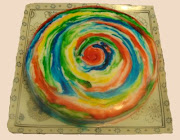
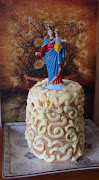
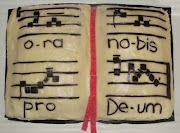
So with St Gregory the Great's feast day almost upon us, I have made a Gregorian Chant Cake, follow the link over to Catholic Cuisine and read how I made it!