Saturday, November 21, 2009

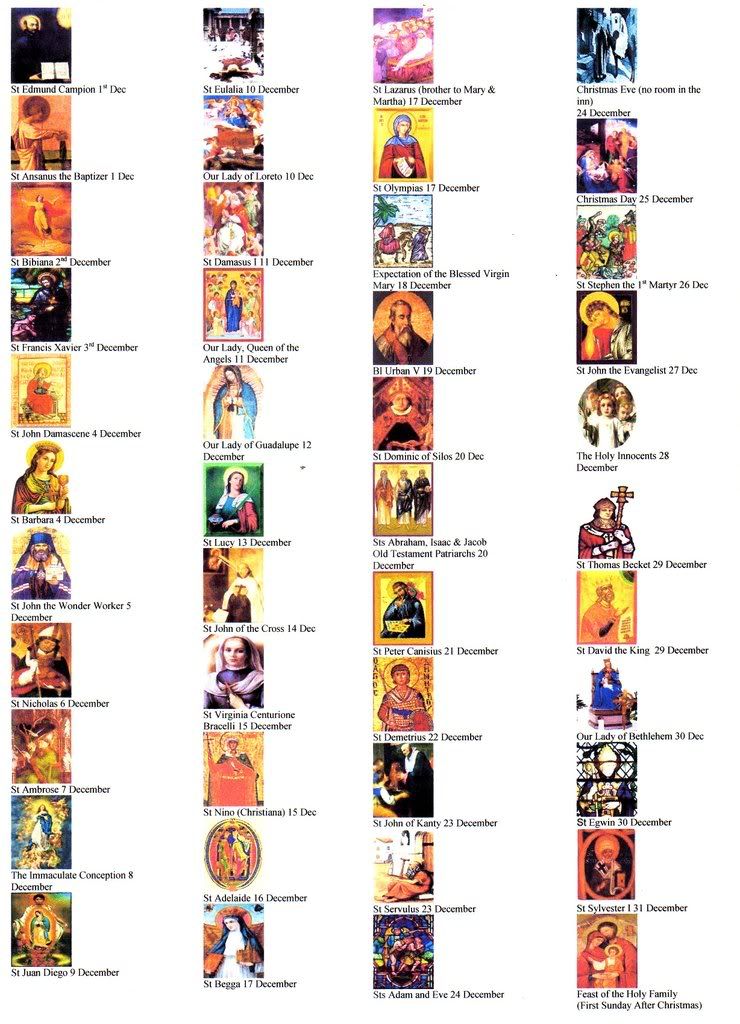
Advent Saints Christmas Tree Ornaments

I had been thinking of some tangible way to recognise the saints throughout the advent season coupled with not being very happy with our christmas tree decorations. My dh says he likes to see a bright tree, FULL of colour.

So I thought up a craft that would meet both needs. ~ Creating a tree ornament for each day during advent, recognising the saints feast days, though I do alter slightly towards the end. Once the 'O Antiphons' come along I swap over to the O Antiphons as there are quite a few obscure saints right to the end and even though we will use our O Antiphon pointsettia wreath it will still be nice to have the O Antiphons represented on the Christmas tree.

The exception at the end is my Sts Adam and Eve ornament that goes up Christmas Eve, their feast day ~ so two ornaments get hung on Christmas eve.

Each ornament has a picture of the saint of the day and the letter that their name begins with.

I have just realised that I didn't make a Christmas Day ornament using the letter 'C' ! I'll make that soon and add it back into this posting at a later date. Though I have found the picture I will use (see below) it is a beautiful painting with Mary and Joseph presenting the Child Jesus to the shepherds, it is surrounded by the blackness of night..so I'll paint the 'C' black and fill it with lots of silver stars, with one big silver or gold star!

I used the following:

MDF Alphabet cutouts (Spotlight and Bunnings sell these in Australia) ~ you can choose this larger size OR you could go for the smaller ones if space and and money are a bit more pressing, they will still look lovely small.

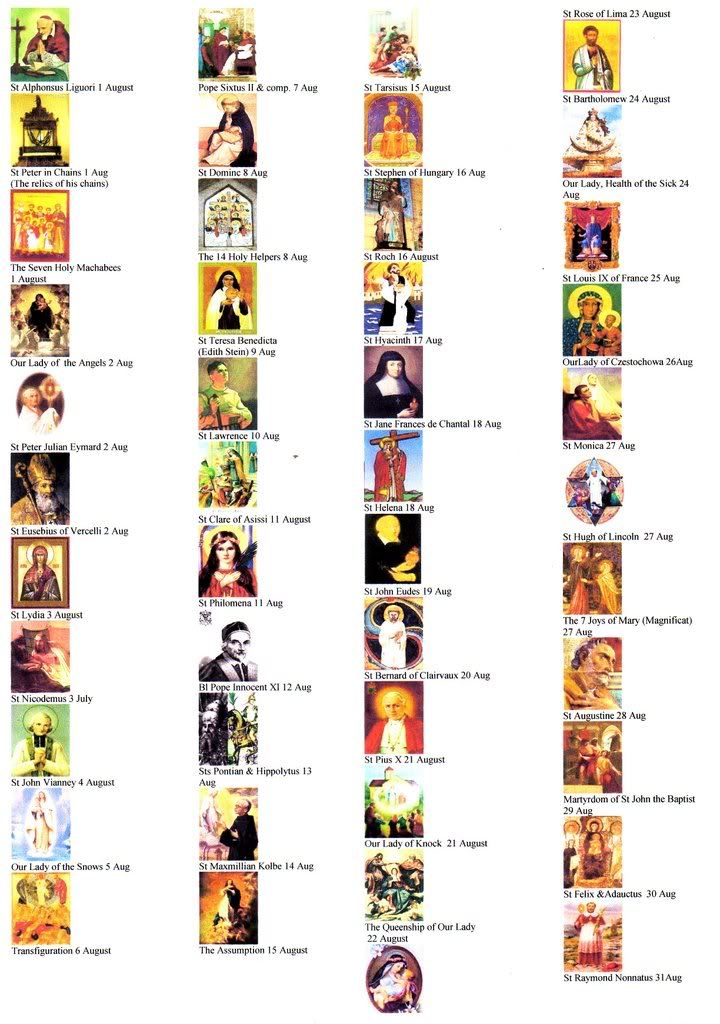
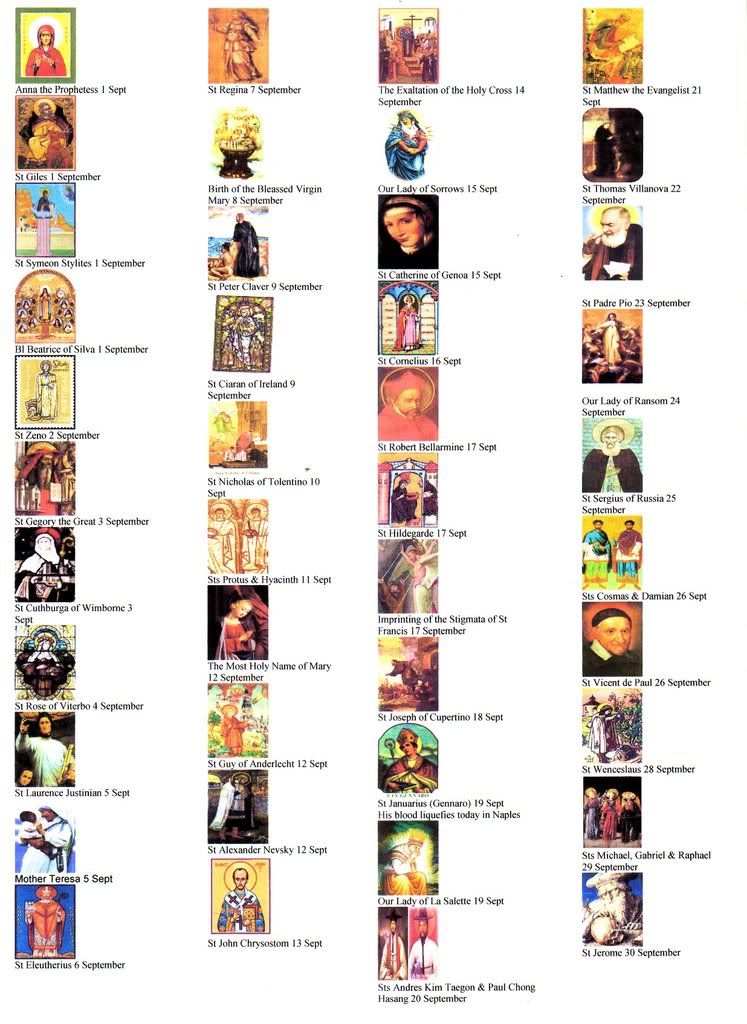
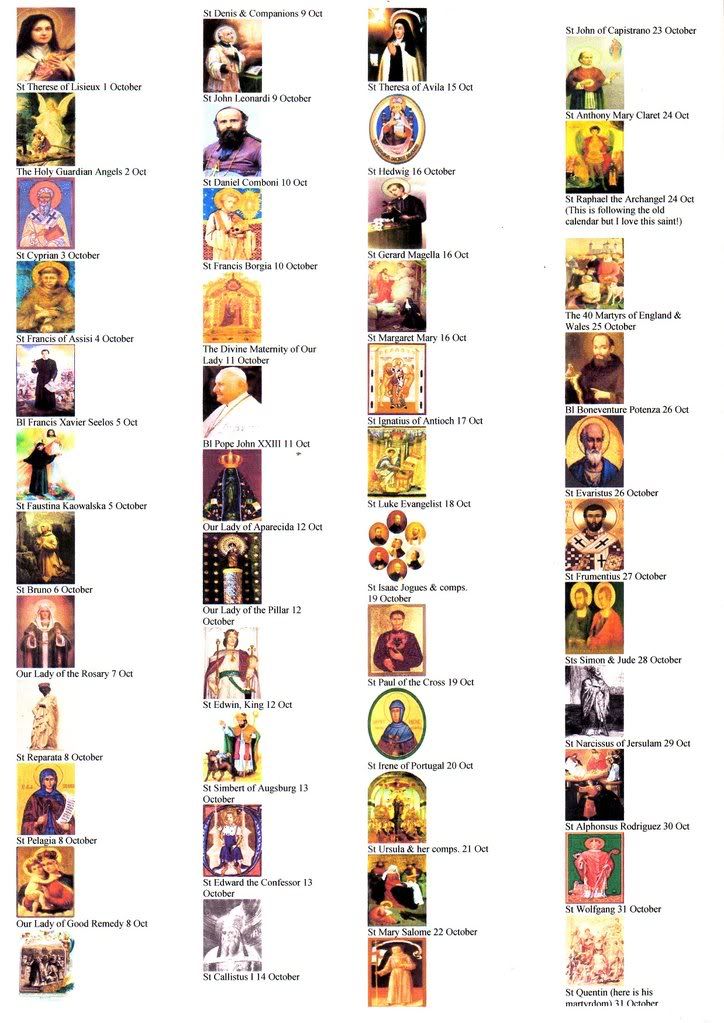
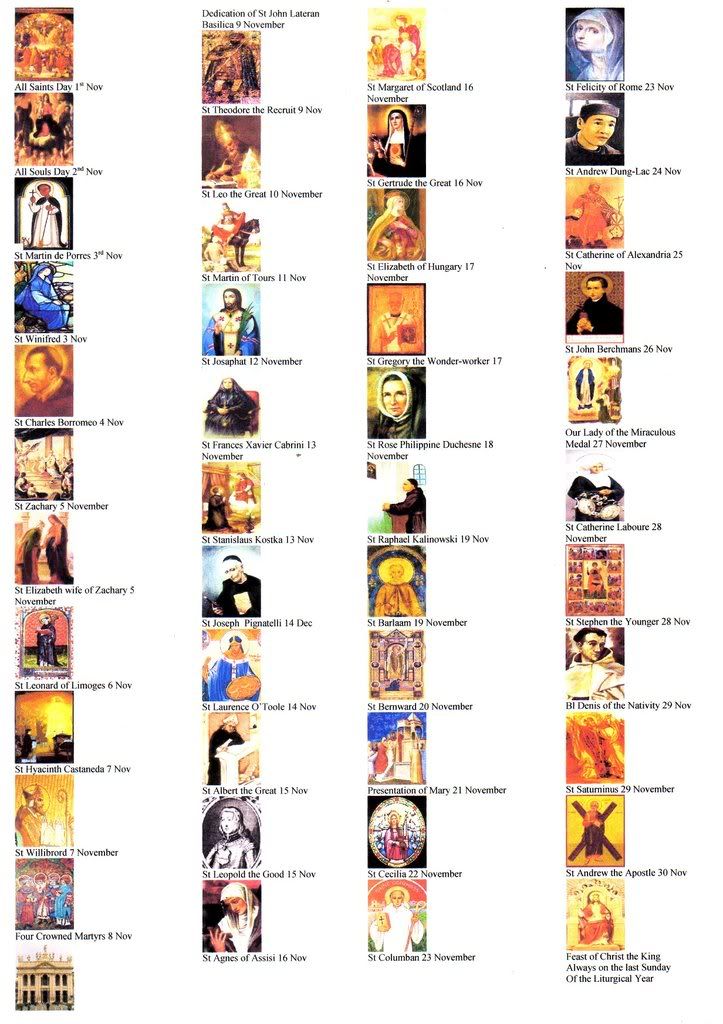
Then I went google image searching and found a nice image for each saint, preferably colourful if I could find one...most are. At the end of the post you can see the images I selected, click on them individually to enlarge and print. I printed them onto cardboard and then laminated them for strength and durability.

I bought a pack of acrylic tube paints in 18 colours to paint the individual alphabet cutouts.

The children had a fanastic production line going on while painting all of these cutouts, from youngest to oldest, they all got in and did their bit! We chose colours that complimented each picture in some way. When the alphabet cutouts were glued to the saint images, wood glue was used, but any good PVA glue would also work.

I had bought some cheap packets of glittery stars, images, balls etc. A lovely variety, some with christmas themes, some with birthday theme (you'll see why soon) and lots of different sized stars.

(You can click on any of the images to see at a larger size)

30th of November ~ St Andrew the Apostle. We took a few snowflake little cutouts and cut off the two side bars to create the traditonal 'St Andrew Cross'. Some of the decorations on the alphabet cutouts have some sort of symbolic meaning, some do not. At the end of the day, as long as they are decorative and eye catching, it doesn't matter if they are or not. We used super glue for sticking on the decorations, as it sticks almost instantly and you can use it sparingly.

1st of December ~ St Edmund Campion. The decorations on this cutout are not symbolic,.

2nd of December ~ St Bibiana. St Bibiana was an early christian martyr, so we used gold and red 'palm-like' cutouts to decorate the alphabet, representing her martyrdom.

3rd of December ~ St Francis Xavier. We used blue/green balls to decorate the alphabet as St Francis was a missionary who travelled the globe converting people to the faith.

4th of December ~ St Barbara. We used little birthday cake cutouts, because they have three candles on top, but to me, they represent St Barbara's love of the Blessed Trinity when she ordered the three windows for her tower. See how I placed the alphabet cutout? One illuminated manuscript scene can be seen through one part of the 'B' and another scene through the other hole.

5th of December ~ St John the Wonder Worker. This one we decorated with no symbolic meaning in mind.

6th of December ~ St Nicholas. We decorated more with colour in mind than anything else with this cutout.

7th of December ~ St Ambrose. We used ballon cutouts with this one, cutting the bottoms of them, making them look like two important symbols ~ a beehive (gold) and a mitre! (red)

8th of December ~ The Immaculate Conception. 12 stars are placed in the 'I' which is very symbolic to Our Lady.

9th of December ~ St Juan Diego. We used christmas tree cutouts and stars representing nature ~ the earth and sky that Juan would have had a great appreciation for as an Aztec.

10th of December ~ Our Lady of Loreto. We used christmas angels and stars as the Holy House of Loreto was transported through the air (stars) by angels. (the angels can be seen in the image as well.)

11th of December ~ St Damacus I. In this image of St Damacus he is surrounded by angels and so we used angels and stars on the cutout as well.

12th of December ~ Our Lady of Guadalupe. The cutout was painted in a burnt brown colour for the sunburst and golden stars for her miraculous starry mantle.

13th of December ~ St Lucy. Well, wouldn't you know it! I had little christmas candles in my christmas miscellaneous mix! So candles and stars it was.

14th of December ~ St John of God. We placed two red palm-like cutouts together to make a heart as the main feature on the 'J' as St John is the patron of heart patients, the rest was decorated randomly.


15th of December ~ St Nino. In this icon image there features an angel, so we decorated the 'N' with angels as well.

16th of December ~ St Adelaide. If you look closely at the image of St Adelaide and her husband, they both wear crowns that look very much like the little birthday cake cutouts used to decorate the 'A'! (click on picture for better details of the crowns)

I will do a separate posting of the 'O Antiphons' which start on the 17th of December and continue through until the 24th.

24th of December ~ Sts Adam and Eve. We used some lovely little balls to decorate the 'A' and the 'E' to represent the apple!

All that needs to be done now is a hole punch in each ornament, to enable some gold thread to feed through for hanging.

Not all are going to be hole-punched ~ with Our Lady of Guadalupe and St Damacus I, have their alphabet cutouts positioned so they peep just over the top of the laminated cardboard, so I can feed the gold thread through.

A couple may also need to have the thread firmly taped from the back since their alpahbet cutout goes up the top and over the center. (Sts Barbara, Francis Xavier and Edmund Campion.)


Wednesday, November 18, 2009

Miraculous Medal Prayer Petition Mobile ~ Made Easier

One of our most practical and blessed, liturgical crafts has been our miraculous medal prayer petition mobile. It can be a blessing for mothers whose brains are flagging and full of so many other things in the course of a busy day and for the children also, who really connect to the 'visible & tangible' when praying for others.

The miraculous medal prayer is so simple for families ~

"Oh Mary, conceived without sin, pray for us who have recourse to thee."

The mobile is there to remind us to recite that prayer often throughout the day and also for the children to see the individual prayers pinned up onto the mobile, a reminder for the times we forget what we are praying for and a beautiful visual for the children.
At the time of the making, it was made very fancy and durable. The durable I recommend, the mobile looks like the day it was made which is what you need, use wood and you won't regret it. The fancy can put some people off, 'can I do this, do I have the time?' is what can come to mind. I feel that instead of using fabric for Our Lady and felt for the back, coloured in pictures of the front and back can look just as beautiful.

If you decide to colour in the pictures (which I have put further down in this posting) you can make it even more attactive, depending on time and resources by doing the following:

~ laminate the images once coloured in.
~ use glue on/stick on stars
~ maybe some gold foil stuck around the crown or some little beads?
~ the use of beads/foiled or decorative paper to highlight sections of the hearts
~ still use beads for the ends of Our Lady's fingers
~ use some sort of stick-on alphabet images instead of painting on the words around the edges

You will still need to buy a little material that will come from Our Lady's hands, where you stick the prayer petitions, anything that is sheer and shiny will help create the look of streams of graces and blessings.

So here are my previous posting on the creation of our mobile:

.

.

The making of the mobile I broke into a two part series, here is Part One.

.


Here is Part Two.


Here is my posting with the finished mobile hung and showcased for the first time.


Here is the first of my practicalities postings - how do you make putting up those prayer petitions, easy and doable?


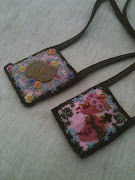
Part of praying the miraculous medal prayer daily is the wearing of the miraculous medal itself. This is not easy with rough and tumble children. They all wear scapulars but medals fall off, so this is what I did in my second practicalities posting.
.
Now below is the images I drew for the front and back of the miraculous medal mobile, feel free to use and pass this free resource onto others. (Click on the images to enlarge and print.)


For the front of the mobile.

For the back of the mobile.

I'd like to add as well, a link to Jenn Miller's posting over at Family in Feast and Feria, she shares a link to free online images to the front and back of the medal, you may prefer to use them!

I hope you have found this tutorial helpful, especially for those who would like to do this craft for the up-and-coming feast day (November 27th) and need planning time in advance.


Thursday, November 12, 2009

Wild Horses, wouldn't drag me away from this beautiful voice...

Photo credit: Sulphur Herd Stallion and Mare ~ Lisa Dearing Photography

My husband and I have loved Susan Boyle from her first incredible entrance into public life. She is a beautiful testament to strong Faith (daily communicant), the love of a large family (the youngest of nine) and to her triumph in bringing the best out of personal struggles and vanquishing prejudice.
Today I heard for the first time, one of the singles off her new album I Dreamed a Dream. The single is Wild Horses, orginally a Rolling Stones song but what she has done with it!! Don't miss listening below, just sit back and close your eyes. This rendition of a poignant song is sure to move you.

We look forward to the new album's release.


Celebrating Martinmas

We haven't been keeping the very best with children dealing with coughs but it still didn't dampen our Martinmas night.

We had cooked a beautiful chicken roast dinner and had intended in setting up a bonfire in the backyard but eating around a fire would not have been good for all those coughs. So we lit our St Martin lanterns and went out, processing around our house, singing a St Martin song.

When we came back inside we darkened the lounge room and placed the St Martin lanterns all around with one by my side (as a reading lamp) where we cut the cake of St Martin's Cloak and had read-alouds with many of the saint compliation books we have that included the life of St Martin of Tours.

The kids loved it and each book we read from gave a different prespective and covered something unique. Next year we will have read alouds around a bonfire!

There were two books were special mentioning.


Our Sunday Visitor's Treasury of Catholic Stories is a lovely compilation. Gerald M Costello collects interesting and unusual stories and facts on the lives of saints and shares not the complete life of a saint but a 'highlighted' event.

Gerald writes about St Martin of Tours on page 209 called, "St Martin's Sacrifice: He Cut His Cape in Two for a Beggar ~ Who Was Jesus Himself" and shares a very interesting connection between...chaplains ~ a capella singing (like chanting Gregorian chant, unaccompanied by an instrument) ~ and the cloak of St Martin.

"The delightful story of St Martin of Tours (c.316-397) giving away half his cloak to a shivering beggar ~ who turned out to be Jesus himself ~ is one of the most familiar in the annals of the saints. Less well known is the fact that as bishop of Tours St Martin went on to become one of the most influential figures in the fourth century Church, especially in the development of Western monasticism.

Here's a facinating sidelight connected with St Martin's life. His cloak was venerated as a sacred relic in a relatively short time after his death, and was kept by the king's soldiers in a small private church. Since the cloak was known by its Latin name, capella, that became the name of the little church housing this important piece of clothing ~ the capella. In time, the name was applied to any small building with an altar intended, to some degree, for private worship ~ capella, in Latin, or, as we know it in English, the chapel. Further, those who had been responsible for guarding the relic in the capella were known as ~ what else? ~ chaplains. And finally, since the typical capella was too small to contain an organ, music that came "from the chapel" was always unaccompanied ~ or, to use the more familiar phrase, a capella.

And to think we owe it all to St Martin of Tours!"

Then the story of the cutting of the cloak begins....I highly recommend this wonderful saint's resource.

Here is a great site that talks in depth about the word, chaplain, I've quoted from parts of it:

Here is the origin of the word chapel:

"ME. chapele, OFr.1 chapele, capele, from ML cappella, LL. capella, dim. of cappa, a cope, cape2; from the cappella or cloak of St. Martin of Tours preserved as a sacred relic in a chapel built for it2-3; the cloak was preserved by the Frankish kings as a sacred relic, was borne before them in battle and used to give sanctity to oaths, and the name “chapel” (and variations) was applied to the sanctuary in which this cloak (cappa or cape) was preserved under the care of its cappellani or “chaplains”1; thence “chapel” generally referred to a sanctuary containing holy relics, attached to a palace, etc., and so to any private sanctuary or holy place . . . the earlier name for which was Oratorium, Oratory.1 "

Here is a good definition of the word chaplains and how it evolved:

"The above classic definitions and etymology of “Chaplain” and “Chapel” reveal a storied history with fairly clear boundaries. Among the greatest aspects of “Chaplain” is that the office is a high order vocation, never a first order vocation. That is, the “Chaplain” is a person who sought out credentials in a faith group and served to some extent and for some time in that faith group prior to assuming the role of “Chaplain.” Only after a period of time and training, does the minister move into the second order of vocation and field of service. A Chaplain is a minister who moved into a specialized ministry setting after a period of service and training (never the reverse).

In essence and historically, a “Chaplain” was sought out from ordained and credentialed clergy to serve as ministers to leaders and kings. The history of St. Martin of Tours illustrates the origin of the term, “chaplain,” and how the term developed into a profession. The clerics who kept charge of the cloak of St. Martin under the Frankish kings were called “chaplains,” and these clerics-termed-chaplains were the first ministers in specialized settings. In the case of the Frankish kings, the first chaplains were military. Since the time of the Frankish kings, throughout the Dark Ages and through the Enlightenment and Reformation, Chaplains were commissioned to serve in settings where the people did not have free and frequent access to a regular clergy person.

For the most part today, a “Chaplain” is a credentialed minister who serves an institution of some sort. Most of the time that institution is a public institution offering a specialized selection of services, and the clients in these specialized environments are to some extent prevented from having free and frequent access to a spiritual and faith-based counselor: like the armed services, hospital services, universities and prisons. Today, even large corporations fall into the category of institutions in the sense of cultivating their own working culture that is somewhat exclusive of the society at large.

For over 1,600 years, since St. Martin of Tours, a Chaplain’s specialized setting was focused upon the total delivery of services within the Chaplain’s own faith. That is, the Chaplain was chosen to minister exclusively to persons of like faith. While practicing the chosen faith and delivering services in these specialized settings, an overall aspect of delivery focused upon faith issues and crisis intervention. The “chapels” evolved and were commissioned as extensions of the church and even in opposition to the established church and always to make clergy-termed-chaplains available to person in faraway places. Said in another way, the Chaplain was made available to those who did not have free and frequent access like those who lived in town or a cathedral city. The services of Chaplains provided faith-based resources to those away from home and in foreign theaters, in the military, in hospitals and in prisons."

Another book that we enjoyed reading from last night was the TAN book, Saints Who Raised the Dead. This book shares 400 stories of saints raising people back to life. St Martin is one of those hallowed saints and he was known as "Trium mortuorum Suscitator" or Raiser of Three Dead.

St Martin is obviously a greatly revered saint in this book as he has a chapter dedicated to him alone, seven pages. His story starts on page 47. What I'd like to share for you in point form is some of the facinating highlights of his life.

~ St Martin's friend Sulpicius Severus, a Roman nobleman in his Dialogues, wrote a biography on the life of St Martin. Here is that biography online.

~ Fourth century Gaul, had christians only in the larger cities. The countryside was mainly pagan, but it would be St Martin that would change that situation. He would go onto set the example of parish organization, bishop's visitations and for pastoral solicitude.

~ St Martin was born in an area of modern Hungary.

~ He was all these things in some time in his life: solider, hermit, monk, founder, bishop, pastor and wonder worker of great miracles.

~ He knew St Hilary of Poitiers who was a bishop, he supported St Hiliary in the fight against Arianism and St Hilary had St Martin ordained an exorcist.

~ St Martin healed a notorious leper who stood at the Porte St Martin (old St Martin's Gate) opposite the Pont au Change in Paris. This converted the Parisians who were a very licentious people.

~ St Martin used Holy Oil with faith and prayer, healing a 12 year old girl who had been mute since birth; many witnesses converted.

~ St Martin prayed one day upon seeing a hugh, stone, cone-shaped temple to a false god in the Gaulish countryside. Through his prayer a storm developed swiftly, which demolished the temple completely. The pagans converted and he built a church for them on the site.

~ After St Martin's death the Bishop Gregory of Tours filled four volumes with the stories of his miracles after his death.

~ He rose three different people to life:

1. One of his monks. The monk recalled that in the hours after his death he was led to the tribunal of a judge and there sentenced to go with 'a vulgar crowd to a region of darkness.' As this sentence was being handed down, two angels came to judge to say that St Martin was praying for this man. The angels then escorted the monk back to his body to be restored to life.

2. The second raising from the dead was when St Martin was walking across the estate of a wealthy family only to hear wails coming from a building. Upon entering the house, St Martin saw that a young slave had hanged himself. St Martin began to pray in front of this lifeless man and he came back to life.

3. The third raising of the dead brought with it a massive conversion to the faith of many pagans who witnessed the event. St Martin was approached by a group of pagans, from amidst this crowd a wailing mother holding her dead child. She came forth and shouted to St Martin, "You are God's friend, bring my son back to life, he is our only son!" St Martin knelt and prayed, restoring this boy to life. The reaction was instant, the pagans wanted to become christians. St Martin laid his hands upon them all and made them catechumens.

I hope your Martinmas day is a blessed one!


Tuesday, November 10, 2009

Cloak of St Martin Cake

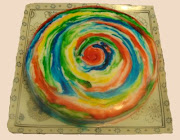
We've just made our sweet treat for Martinmas Day, pop over to Catholic Cuisine to see how we made it.


It's DEFINATELY not too late to be making St Martin Lanterns!

...Because Charlotte over at Waltzing Matilda has given us the easiest lanterns to make that look simply fantastic!!! I'm still short one, so my worries are now over. Pop on over and she how she did it!


Monday, November 9, 2009

St Martin Paper Mache Lantern

Here is another type of St Martin lantern the children have made ~ this time using paper mache. This paper mache lantern has a 'porthole' at the front with a St Martin image on it as well as 7 'peaks' around the porthole with a hole at the top of each peak, representing St Martin being filled with the 7 gifts of the Holy Spirit.

Here are the lanterns we made the day before, in my opinion these are the easiest make and the most eye catching, so click over to the posting on how to make them, where you can also hear the St Martin song that goes with them and the lyrics.

Here is the completed St Martin paper mache lantern in the daylight (not quite finished actually, hadn't finished the top of the latern, you'll see that picture futher on.)

We started with a ballon and then we traced our porthole with a felt pen, placing it central on the balloon. You can see the paper we are using on the sides, we used tissue paper. We SHOULD have had two lanterns to show you, but one of the children did not put enough paper layers on the balloon, so when it dried and the balloon popped, it imploded. So make sure that with this thin paper, you put on enough layers for the balloon to hold together.

We used store bought paper mache glue but I wish I had made my own. I will next time. The layers of paper were glued on to the balloon, making sure that we did not glue into the porthole area.

This is how it should look when completed ~ remember, make sure you have a good thickness with this thin, tissue paper! We used one full packet ($1.50) for each balloon.

Next step was to make the 'porthole' we used some of the tracing paper we had left over from the other St Martin lantern project. The circle of paper had to be about 3 inches (7-8cms) wider than the porthole itself. The children then traced the image below:

HT: Heraldry of the World ...onto the tracing paper and then coloured it in with crayons.

With a lead pencil, lightly mark out the inner circle....

Then carefully cut inward, around the circle, making sure you do not go beyond the inner circle, then once you have done that, you can rub out the inner circle marked with pencil.

Place that porthole over the paper mache balloon, where the porthole is marked out to go, then start glueing the sides down, quickly followed by glueing more tissue paper over the top to firmly hold the sides in place.

It should look like this. Now onto sticking the 7 peaks around the paper mache. (You may be happy enough to leave it without the peaks of course, depending on your time and resources.)

I just grabbed a egg carton tray and cut out individual peaks like this:

The children made holes in the top of each peak, we were hoping that the light would come out of each peak, it does, but not alot of light.

Each peak was paper mached around the porthole, securing them to the balloon.

The tissue paper was placed all over the peaks like this, with only the little hole showing at the top.
We hung the balloons out to dry (that is where one popped and imploded due to not having enough tissue paper around it.) and then when they were dry, it was brought in, the balloon was popped and the top cut out. Four paper fasterners were placed around the opening with wool attached to them.

Here it is, all lit up and ready to go!!


Saturday, November 7, 2009

St Martin Lanterns and Songs!

My children have been crafting today and had lots of fun creating their St Martin lanterns for his feast on the 11th November.

We used tracing paper, black cardboard, sticky tape, black wool, crayons.

I found some images on the net connected to St Martin, the first image is from a free colouring pages site called, 123 coloring. They have this webpage with many different geese images and we chose this one to use for the first lantern:


Click on image to enlarge.

Why geese? St Martin is associated with these loud but delightful birds, wikipedia says this:

"According to legend, Martin was reluctant to become bishop, which is why he hid in a stable filled with geese. The noise made by the geese betrayed his location to the people who were looking for him."


I printed up the images from the computer and allowed the children to trace the image onto tracing paper which also makes the perfect paper for making laterns being so transparent. They then coloured the image with crayons.

I used two wide strips of black cardboard to top and tail the image and then two thin strips of black cardboard along the edge, with more plain tracing paper on the other sides of the thin, black edges. It was then wrapped around into a tube and stuck together with tape. A cardboard bottom was cut for the floor of the lantern. Four stands of black wool attached at the top and it was completed.

Here is George's geese all lit up! I've used a small candle, similar to a tea-light, at the base, I put a bit of double sided tape at the bottom of the candle, before popping it in.

Here is another lantern, with Charlotte's image of St Martin.

To use that image click over to Charlotte's Waltzing Matilda blog where you can download the image.

The image below came from Kinderschule.

Click on image to enlarge.

My Faustina (12) worked on this image and coloured it beautifully:

Here it is being made into a lantern:

Here it is completed, ready to be lit:

Faustina holds it proudly!

The children really wish it was St Martin's day already, they had so much fun trying them out in the dark!

The final lantern is little Ambrose (4) he coloured in this image below that I found at Heraldry of the World:


Click on image to enlarge.

There he is peeping behind his creation!!

Running around in the darkness with their St Martin lanterns, we hope to make a couple of paper mache lanterns tomorrow to complete our line up and so I hope to share them soon.

We are now working on learning one of the traditional St Martin lantern songs, I found this music sheet here with the lyrics. HT: Pinewood Castle
Or here is the lyrics without music notation, click the lyrics open to enlarge and print.

Finally, here those English lyrics put to music in this youtube video:


We are all looking forward to this wonderful saint's feast day!


Tuesday, November 3, 2009

November craft display for All Saints & All Souls

I was searching for lovely November crafts to remember the Holy Souls and acknowledge all the saints in heaven. I found Jen's (Wildflowers and Marbles) beautiful altar display craft that was particularly inspirational. It reminded me of an image from childhood, when my mother use to teach me my daily catechism:

I really wanted to convey this image to my children and be able to reflect upon it daily. It would be a great reminder in the home that the Holy Souls who are completely helpless, need our prayers.

Now I'd like to say that even though this craft looks complicated and hard, it is quite easy and not as time consuming as you might think. It may look expensive, but really there was no real expense except for the 60cm x 90cm painter's canvas, which I was fortunate to buy at a super cheap shop for $15. In otherwords, this is doable with the children, and will provide alot of fun for you all in the making!

The Church comprises of three parts which make up the complete Body of Christ or Communion of Saints. Death does not separate us, as Our Lord said Himself, (Mark 12: 26-27)

26 "As for the dead being raised, have you not read in the Book of Moses, in the passage about the bush, how God told him, 'I am the God of Abraham, (the) God of Isaac, and (the) God of Jacob'? 27 He is not God of the dead but of the living. You are greatly misled."

The complete Church supports each other by prayer and sacrifice:

Lets look at the first half of the craft: The Church Triumphant. This the the Church of saints in heaven and we celebrate these members on the feast of All Saints. They do not need our prayer but the Church Suffering and the Church Militiant are in much need of their intercessory prayer. We think of this Bible passage, (Heb 12:1-2)

“Since we are surrounded by so great a cloud of witnesses [saints], let us lay aside every earthly care and … run with perseverance the race that is set before us, looking to Jesus, the author and finisher of our faith …”

and these passages (1 Pet 3:12) & (James 5:16)

"For the eyes of the Lord are on the righteous and his ears are attentive to their prayer.."

"...A good man's prayer is powerful and effective."

We do not interceed to dead people, (dead in the sense they are damned, lost souls) we pray to the living saints of God who are now completely righteous through God's saving grace, as the Bible quote from Mark's Gospel reminds us above.

The blue arrows indicate that the saints in heaven are praying for the souls suffering in purgatory and souls on earth.


Here is the middle part of the craft, The Church Suffering: These are souls who have been saved but upon death, were not completely freed from smaller sins and failings, and as the Bible reminds us: (Rev 21:27)

"Nothing impure will ever enter it, nor will anyone who does what is shameful or deceitful, but only those whose names are written in the Lamb's book of life."

Our understand of purgatory comes from scripture where it is said: (1 Cor 3:12-15)

12 "Now if any man builds on the foundation with gold, silver, precious stones, wood, hay, straw, 13 each man’s work will become evident; for the day will show it because it is to be revealed with fire, and the fire itself will test the quality of each man’s work. 14 If any man’s work which he has built on it remains, he will receive a reward. 15 If any man’s work is burned up, he will suffer loss; but he himself will be saved, yet so as through fire. "

The Holy Souls are blessed, they have the assurance of their salvation, but they are suffering as they do penance for the sins they committed on earth that they did not make full atonement for.

They are helpless. They cannot help themselves to pass through this place of suffering, faster than expected. They rely on our prayers and sacrifices. While they cannot help themselves, they can pray for us in thanksgiving, especially once they have entered their blessed homeland ~ heaven.


The bottom end of the craft is the Church Militant: That is ourselves, upon earth striving for salvation: (Philippians 2:12)

12 "Why, my beloved, as you have always obeyed, not as in my presence only, but now much more in my absence, work out your own salvation with fear and trembling."

Wikipedia says this:

"The Latin word militans has a primary meaning of "serving as a soldier, miltary", but it acquired a secondary meaning of "to struggle, to make an effort", which is the intended sense here. Christians on earth (the Church Militant) are still struggling against sin in order that, when they die, they might go to heaven and be members of the Church Triumphant, those who have triumphed over sin. However, if this struggle is successful, but not completely so, then after death they temporarily become members of the Church Suffering before ultimately joining the Church Triumphant."

We are able to pray for ourselves as the passages above reminded us: (1 Pet 3:12) & (James 5:16)

The offering of the Holy Sacrifice of the Mass on earth for people on earth and for the Holy Souls. We also pray for priests (spiritual motherhood) and for religious. They in turn pray mightily for the whole world and are that powerful human arm of prayer and sacrifice that often holds back God's Divine arm of justice that weighs heavily over us. (We read about that in particular in the Diary of St Faustina.) Our Lady of Fatima reminded us that "some souls go to Hell because they have no one to pray for them."

We can also pray for the Holy Souls suffering in purgatory. We rely on the intercessory prayers of the saints in heaven and also the Holy Souls who finally enter the Church Triumphant.

This is the mystical body of Christ.

Making the craft

Below you will see the images I used to make the craft. You can click open any of the images and use to print up onto normal sized paper (I used cardboard). I then laminated each image for strength and durability. I used the following things:

Good quality, wide sticky tape.
Paper Fasteners 25mm
Pack of styrofoam cups (cost me $1.50 at cheap shop)
Pack of cotton balls (cost me $1.50 at supermarket)
PVA glue
On pack each of red and yellow cellophane.
60cm x 90cm painter's canvas.

All the images are layered and I created this by using the styrofoam cups as you can see below.

I used three different sizings for the cups ~ a full cup ~ medium cup, cutting a cup down by an inch (few cms) ~ small cup, cutting a cup so it's an inch big (few cms).

So some of the images stand out futher than others. The Vatican image is the only image attached directly to the board.

I pressed a paper fastener through the bottom of the cup and through the canvas and spread the two ends out behind the canvas to secure the paper cups very well to the canvas. I placed sticky tap around the bottom of the cup to the canvas to limit any movement. I then put tape around the tops of the cups and attached the images to the cup in that way.

This is what the paper fasteners look like at the back of the canvas, I placed some sticky tape over the top of them for extra security.

Now don't forget to find a photo of your family to print up and laminate, it will be backed with a small sized cup.

With the images below you need to print up and cut main images out.


Medium sized cup for this image.

Medium sized cup for this image (I used two cups for this big picture)

This image is stuck directly onto the canvas.

Full sized cup used behind this image (I used one cup, but you could use two at either end for better stability.)
This angel is stuck onto the first row of saints, I used half a cup rim, each end of the rim sticky taped to the left hand side of the saints and I used double sided tap on the top of the arch to secure the angel image to it.
These angels are sticky taped onto the right hand side of the Holy Spirit halo, up the very top of the craft, the bottom of the angels is sticky taped to the side of Jesus on the cross.

This angel is stuck onto the first row of saints on the left hand side, I used half a cup rim, each end of the rim sticky taped to the right hand side of the saints and I used double sided tap on the top of the arch to secure the angel image to it.

These angels are sticky taped onto the left hand side of the Holy Spirit halo, up the very top of the craft, the bottom of the angels is sticky taped to the side of Jesus on the cross.

The Holy Spirit halo is sticky taped just behind the head of Our Heavenly Father.

This image has a full sized cup behind it. (I used two cups with this image)

This saints image is the bottom, right hand row of saints and I used a medium cup behind it.

This row of saints is the bottom, left hand row of saints and I used a medium sized cup behind it.

This row of saints is the top, right hand group and I used a small sized cup behind it.

This row of saints is the top, left hand group and I used a small sized cup behind it.

Our Lady is positioned just under Jesus and the Heavenly Father, she has a full sized cup behind her (two actually) and I sticky taped her top end to the bottom end of Jesus and the Heavenly Father for extra stability. Our Lady as the Mediatrix of All Grace, passes the graces from the saints in heaven and the souls on earth, to these poor, suffering souls. She interceeds to her Divine Son for us all.

With this image I printed up two, one like this and then I put it into paintshop and made a mirror copy. Then I cut each image in half. Two are placed either side of Our Lady using a medium cup behind each image. The other two images are on the outside of the board, using a small sized cup behind each image. I used sticky tape to attach red and yellow cellophane all around the four purgatory images.

I then stuck cotton balls all around the areas you can see it, as well as onto the canvas directly behind the Holy Spirit halo and the two, top rows of saints. Then I made up the arrows and sticky taped them in place ~ all done!


Monday, November 2, 2009

Remembering the Holy Souls in November

This morning on the feast of the Holy Souls, my children and some lovely friends worked on a poster for the home that is to stay up in the whole of November. It is our reminder...dare I say it, I have decided to stick this particular one in the 'powder room' where it will receive individual attention, everyday without fail ~ a simple fact of life.

It was a quick and easy craft. I found some images online to colour, I created the centerpiece using an image online and the children coloured in and pasted the whole lot together.

Here is a closeup of the middle section. You can see a stone angel reclining on a stone gravestone, in that image I have written the individual names of people we intend to pray for throughout the whole month of November. Below the names is the 'Eternal Rest' prayer.

Here is the sheet, you are welcome to click on the image to enlarge and print up for this craft.

A found this lovely little image of Our Lady assisting the Holy Souls for the children to colour in.

And this one for the bottom of the poster, it was all coloured in and stuck on.

Lastly I used this free image of the Crucifixion colouring image for the top of the poster. HT: sjtbre.org
Here is a sneak peak of another November craft I'm working on. It was inspired by Jen's beautiful altar craft (Wildflowers and Marbles.) I was captivated with the idea of combining All Saints ~ All Souls in presenting the three churchs ~ The Church Triumphant ~ The Church Suffering ~ The Church Militant.

I remember my mother teaching me about these three churchs in one of the Baltimore catechisms and seeing the diagram that showed me how they all interacted with each other through God's grace...this is what I hope to convey to my children as a lovely, big, visual reminder. So I'll be back tomorrow with the completed craft.